seolist.org
A human-review directory, we provide the most deep-diving website review service for SEO businesses
★ Get your own unique FAQ + Selling Points on your profile page
★ be seen by 1000s of daily visitors and win new business
seolist.org Miniblog
Google Finally Revealed Its Hidden Clockwork
 Google has finally lifted the panel on a machine it usually keeps humming behind the walls. At a Search Central Live Deep Dive event in Europe, Gary Illyes shared internal timing data showing how long Search typically takes to crawl, index and serve changes.
That matters because the process is not one click, one result. Google has to discover fresh pages, revisit old ones, process sitemaps and robots.txt, render content, choose canonicals, read structured data, attach link signals, handle removals, and then decide what searchers actually see in snippets and titles. Some changes can appear quickly. Others move with the patience of gears.
The figures came from Google’s own slides, circulated after the event, and cover typical timings as well as slower cases. Barry Schwartz pulled the details together from notes by John Campbell, while Neil McCarthy shared the presentation images. Illyes said the idea was simply to test whether the audience could relate to numbers Google had gathered internally. By his account, the reaction was broadly fine.
A few details raise eyebrows. One slide suggested spam updates can roll out in one to two days, yet the September 2026 spam update is expected to take about two weeks. Another point hints that some serving and reference batching can continue for months.
For site owners, the value is plain: make a change, then judge it against Google’s clock, not your own impatience.
Posted on 6 October 2026
Google Turns 28: The Updates That Changed SEO
 For a while, “good” backlinks looked simple enough: get more of them and rankings rose. That was the seduction. Then Penguin arrived in 2012 and made a mess of that logic by going after link spam, exposing how easily quantity had been mistaken for quality.
It did not make genuinely earned links dangerous. It made manipulative links look risky, which is not the same thing, though plenty of site owners felt the difference only after traffic dropped. Penguin mattered because it challenged a habit that had become normal: treating backlinks as a numbers exercise instead of a sign of trust. By 2016, it was folded into Google’s core systems, which tells you this was not a passing mood.
The wider pattern is familiar. Panda in 2011 pushed thin, low-value pages aside in favour of original, useful content. Hummingbird in 2013 improved how Google understood meaning, not just exact keywords. The mobile-friendly update landed in 2015, and mobile-first crawling and indexing followed from 2016. BERT later sharpened Google’s grasp of language and intent. Then the Helpful Content Update, introduced in 2022 and added to core systems in 2024, reinforced the same message: write for people, not just rankings.
Google turns 28 in 2026. SEO is still here. It has just spent decades learning that a tactic can look smart one year and suspect the next.
Posted on 27 September 2026
Prominent Links, Fewer Clicks: Google's Newest Publisher Squeeze
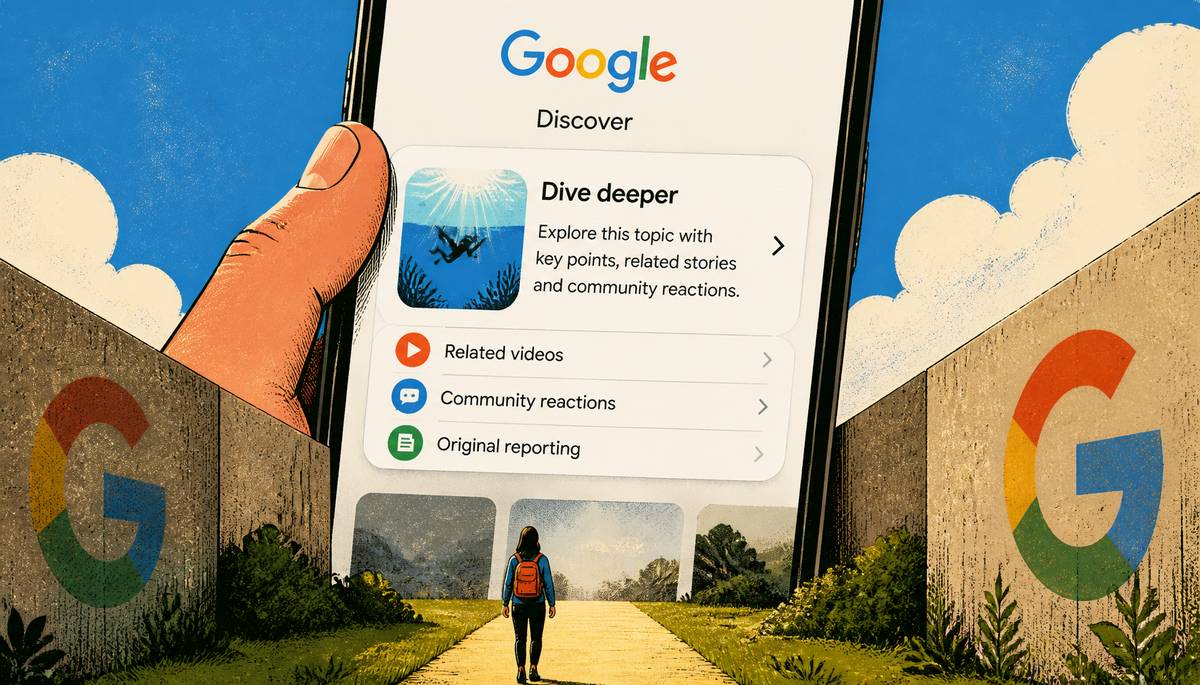 Google has found a fresh way to say “here are links” while quietly keeping readers on Google.
The company is testing a new Google Discover feature called “Dive deeper”, announced by Robby Stein, that inserts a topic summary into the feed where a publisher card might otherwise appear. Tap it, and users get a compact explainer plus links to related stories, community reactions and original reporting. It’s starting with videos, with more formats and designs expected in the coming weeks.
On paper, those links are meant to be more visible. In practice, this looks like another layer between publishers and the audience. If a reader gets the gist, the context and a neat little menu of follow-up material without leaving Google, the urge to click through shrinks fast. Prominent links are still links, sure. They’re just sitting behind Google’s own framing now.
That matters because Discover has become one of the few reliable traffic taps left for many publishers. Search referrals have already thinned out; Discover was the bit still coughing up visitors. Replacing direct publisher exposure with a Google-built summary card risks turning that trickle into something meaner.
Google says it’s trying to make topic exploration easier. Fair enough. Publishers may look at the same test and see a familiar pattern: more Google, fewer clicks, and another polite squeeze dressed up as convenience.
Posted on 22 September 2026
The Real Bet Is Not ChatGPT Ads - It's Ad Creation By Prompt
 OpenAI’s newest advertising move looks flashy on the surface: sponsored brand chats inside ChatGPT, where a user can peel off into a clearly labelled conversation with a business after seeing an ad. Ask about fit, features or compatibility, get answers, then click through when ready. OpenAI says these sponsored chats are kept separate from both its own answers and the user’s original conversation, and that advertisers still do not see private chats.
Interesting, yes. But the bigger wager is elsewhere.
The more consequential shift is that ad creation, editing, analysis and optimisation are being folded into a conversational workflow. Through ChatGPT Work and an Ads Manager plugin, advertisers can build or tweak campaigns in plain language, potentially starting from little more than a website or brief. OpenAI is also offering assistance with copy and images drawn from landing pages and campaign goals, with brands retaining the final say before anything runs.
Then comes the practical plumbing. Text can be tailored to the context of a conversation and translated into a user’s preferred language. HubSpot links ad activity more closely to CRM data and follow-up. Shopify merchants in the US can create campaigns, manage them and track results, while product data already feeds shopping conversations more accurately.
That is the real story: not ads as interruption, but advertising compressed into instructions, edits and iterations. The ad unit may get the headlines. The workflow is where the money likely sits.
Posted on 18 September 2026
Why Are Backlinks Still Beating Google's Own Talking Points?
 Google keeps trying to persuade the public that links are less central than SEOs imagine. SEOs, meanwhile, keep looking at the search results and reaching a different conclusion. A new Zyppy survey of 131 SEO professionals makes that tension plain: 54.8% put backlinks among Google’s three most important ranking factors, second only to relevance at 57.1%, with content quality close behind.
That gap matters. Google’s Gary Illyes has said links are not in the top three signals, yet practitioners still see trusted, topically aligned backlinks from pages with genuine traffic as highly influential. Bad links, by contrast, were judged a strong negative.
The strongest single factor in the survey was search intent. Not keyword matching in the narrow sense, but meeting the user’s actual aim. That suggests rankings are often won by usefulness, then reinforced by authority.
There were other telling results. Meta descriptions were seen as having little direct ranking value. Original research and first-party data scored strongly, especially compared with scaled content that adds little. Human-reviewed content with something new to say fared far better.
Technical SEO still looks like the plumbing: crawling, indexing, site health and internal linking remain essential. And user signals matter too. Satisfaction, task completion and brand strength rated well, while a quick return to the search results page was seen as a bad sign.
Posted on 13 September 2026
Amazon Fell Harder Than Most People Realize - What's Draining Its Traffic?
 Amazon’s traffic has taken a nastier tumble than many people seem to clock. Over the past year in the U.S., visits to the site fell 15.31%, a sharp wobble for a platform usually treated like the great humming engine of online shopping.
That matters because the rest of the web’s pecking order looks oddly calm at first glance. Google is still sitting on 25.3 billion monthly visits, up 10.72%. YouTube is still a colossal beast at 10.3 billion, but its rise is far wilder: 36.6%. Reddit remains third. The top names haven’t changed much. The currents underneath them have.
Amazon’s slide stands out because it isn’t happening in isolation. Bing dropped 50.43%. DuckDuckGo fell 15.83%. Yahoo lost 13.82%. Even ESPN and NBCNews.com were knocked backwards. Traffic isn’t vanishing in a puff of glitter. It’s being siphoned off unevenly.
One obvious suction point is ChatGPT.com, which surged 48.38% to 1.09 billion monthly visits, climbing to ninth place in the U.S. and overtaking both Bing and DuckDuckGo. Utility sites are holding up too: USPS grew 12.04%, LinkedIn rose 15.48%, and Twitch jumped 25.6%.
So what’s draining Amazon? Not one single gremlin. More likely a cocktail of shifting habits, tighter concentration at the top of the web, and users spending more time getting answers, recommendations and distractions somewhere else first.
Posted on 5 September 2026
Why Is Google Hiding Search Result Links Behind A Redirect?
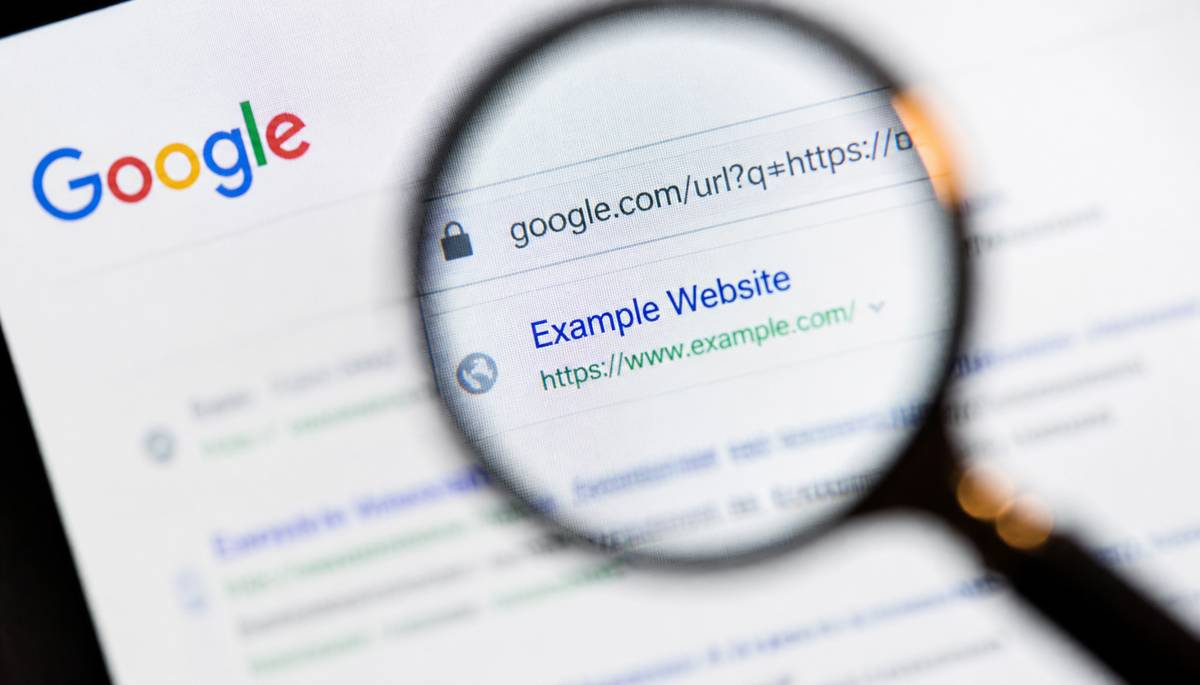 Google has started putting a redirect between its search results and the page you actually want to visit. So instead of clicking a result and going straight to a site’s full web address, some users are now being routed through a Google URL with a “goto” parameter before landing on the destination.
Google says this is a defensive move. The company told reporters it regularly adds technical safeguards to counter abuse and protect both its services and users. Read between the lines and the target seems pretty clear: scrapers, rank-tracking tools, and other third-party systems that rely on clean search result links. That matters, especially after Google’s long-running fight with scraping services such as SerpAPI.
This is not just a tiny experiment. Derek Perkins of Nozzle said he is seeing close to a full rollout across several residential IP networks, suggesting the change is now broadly live after months of testing.
For ordinary searchers, the impact is small but not zero. You still see the website address under the result, but you may no longer get the full destination URL in the browser bar before clicking. Most people won’t notice. SEO tool providers probably will.
If your search tracking data starts looking odd, this redirect layer could be the reason. Google Search Console, though, is expected to stay unaffected.
Posted on 29 August 2026
Google's Quietest AI Max Update May Be The One Location-Obsessed Brands Have Been Waiting For
 Google’s latest AI Max changes are not the loudest update it has made, but for advertisers with strict geographic rules they may be the most useful.
From September, Google will let advertisers run a single A/B test across multiple Search campaigns, comparing different budgets and ROI targets in one go. That matters because budget shifts rarely affect one campaign in isolation. Brands can now get a broader read on what happens to overall performance before increasing spend.
The more interesting move, though, is support for experiments that keep brand and location controls switched on. Until now, that kind of restriction could make testing awkward or less realistic. For businesses tied to specific regions, franchise networks or tightly managed brand terms, this makes AI Max far easier to assess in conditions that actually resemble the live account.
Google is also widening what Performance Planner can do. Advertisers will be able to forecast how changes to bids, budgets and targets might affect current campaigns, then push Google’s recommendations live with a single click. It shortens the gap between planning and action, for better or worse, depending on how much autonomy a brand is willing to hand over.
The practical takeaway is clear: Google wants AI Max to feel less like a leap of faith and more like a measured test.
Posted on 23 August 2026
Why Is ChatGPT Rewarding Pages Updated In The Past 30 Days?
 ChatGPT seems especially fond of pages touched up in the last 30 days because recency acts like a fresh set of footprints in wet cement: clear, current, and easier to trust. Research backs that up. SE Ranking found that 76.4% of ChatGPT’s top-cited pages had been updated within the previous month. AirOps reported that more than 70% of cited pages were refreshed within a year, and Ahrefs found the average cited URL was 25.7% newer than those turning up in standard search.
That makes sense. If a page has just been updated, it is more likely to reflect today’s opening hours, prices, stock, services, and reviews rather than the digital equivalent of a damp leaflet under a car seat.
Freshness is only part of it, though. Pages also tend to perform better when they come from brands that look established, stay consistent across key platforms, and earn proper trust from customers. SOCi’s findings suggest Google Maps, business websites, Yelp, and Facebook are the main sources used for local answers, yet many brands still leave gaps. Nearly all locations had a claimed Google profile, but only 80% had Yelp and 53% had Facebook store pages managed. No wonder citation accuracy sat at about 79%.
Add stronger reviews too: recommended businesses averaged 4.4 stars. In short, recent updates help, but only if the rest of the house isn’t on stilts.
Posted on 16 August 2026
Why Is Google Sneaking AI Buttons Onto The Most Sacred Page On The Internet?
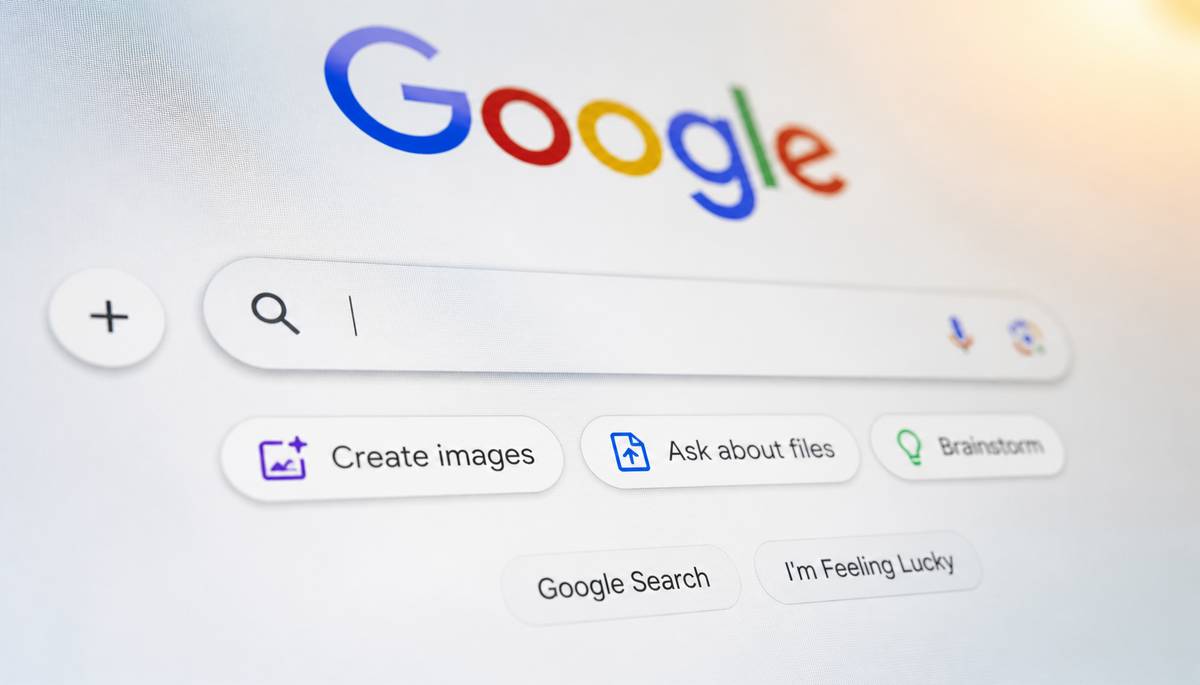 Google’s homepage has long functioned like a secular altar: a blank field, two buttons, and the promise that intent alone would summon the world. So it’s telling that the company is now fiddling with this liturgy.
Google has confirmed it is running a small desktop test that places extra buttons beneath the search box, nudging users towards its newer search tools. The additions include “create images”, “ask about files” and “brainstorm”. Click one and you’re steered into Google’s AI Mode.
Robby Stein, the company’s vice-president of product, said on X that the experiment is meant to help people discover more things Search can do. He also stressed that the central mechanism remains intact: type your query, press enter, proceed as normal. Fair enough. But that reassurance rather gives the game away. If people were naturally finding these features, Google wouldn’t need to staple signposts onto its most carefully preserved page.
The change appears under the plus symbol to the left of the search bar, which suggests Google knows subtlety still matters here. This is not yet a redesign, more a tentative incursion. Still, if it spreads, it could alter how users encounter these tools. Then again, many of us have spent two decades blanking “I’m Feeling Lucky”. Habit is a formidable editor. Posted on 12 August 2026
Inside The New Ad That Sends You To An AI Salesperson
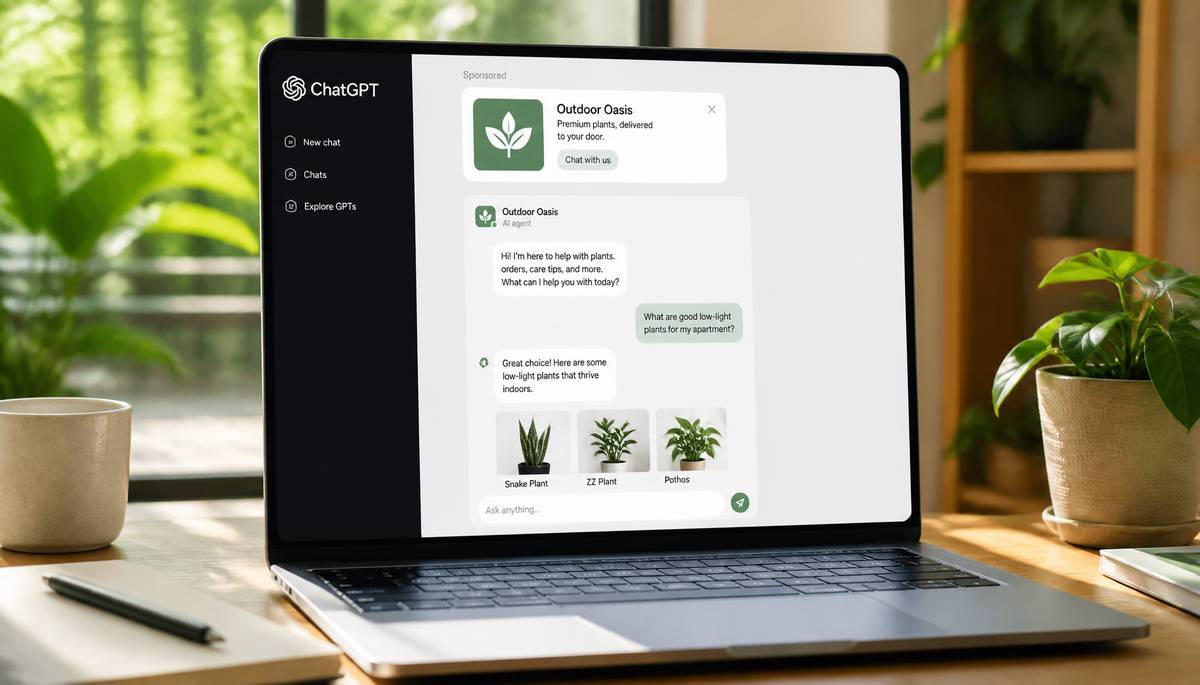 Click an ad, expect a website. That’s been the internet’s whole little routine for years. OpenAI seems keen to bin that habit.
A new ad format being tested inside ChatGPT appears to send people straight into a chat with a business-specific sales or support bot, rather than off to a landing page. So instead of squinting at pop-ups and hunting for the returns policy, users could ask questions immediately, get product suggestions, book appointments, sort basic problems, or hand over their details.
The setup reportedly works in three stages. First, ChatGPT scans a company’s website and builds a profile of the business, including common customer queries, support details and general background. Then the advertiser shapes a branded agent using extra instructions and added data, such as product feeds, live business information via Model Context Protocol tools, and lead-capture forms. After that, campaigns can direct users into a conversation with that agent instead of to a URL.
It appears to sit on the same underlying system as Custom GPTs, which makes the whole thing feel less like a random experiment and more like a serious test of a new ad model.
The big shift is simple: the conversation becomes the destination. These tools are said to be live in ChatGPT Ads Manager for a limited group of advertisers, though the public-facing ad experience still hasn’t been widely seen. Posted on 3 August 2026
How Did "Private" Claude Chats End Up On Google?
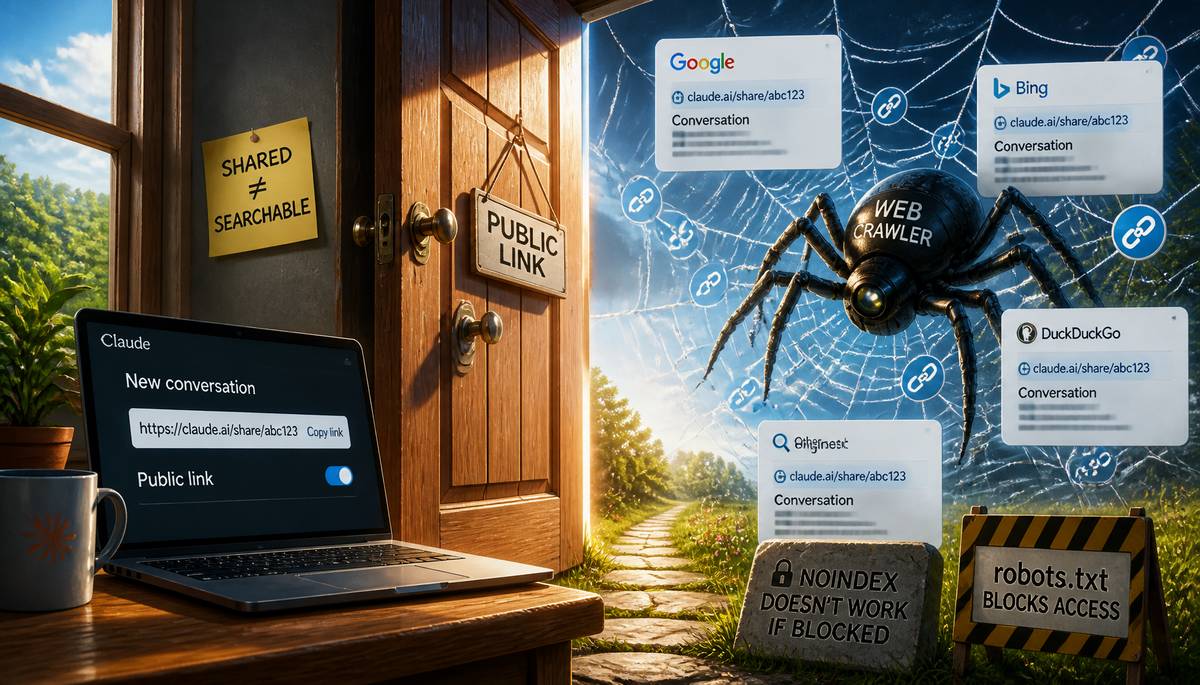 Private chats do not slip into Google by magic. They get there because somebody leaves a door open.
That appears to be what happened with shared Claude conversations, some of which surfaced in Google, Bing and other search engines before being removed. Reports found indexed chat pages covering sensitive subjects, including health. The key detail is simple: Claude lets people create public share links, and those links were accessible enough for search engines to find.
The technical mistake seems to have been a basic one. If a page is blocked in robots.txt, a search engine may be unable to crawl it and therefore unable to see a noindex instruction on the page itself. Google has long warned about this exact problem: noindex only works if the crawler can actually access the page. If other pages link to a URL, it can still appear in results.
That is why this was less a search engine failure than a publishing controls failure. Google’s search team said it does not decide what is made public and that it honours site-owner directives. The same pages were reportedly indexed across multiple search engines, which supports that view.
The larger lesson is old-fashioned and unglamorous: visibility controls matter. If a service offers public links, it must handle indexing rules with care, especially when users may assume “shared” does not mean “searchable”.
Posted on 29 July 2026
Fake Reviews In Structured Data Are Now Officially In Google's Crosshairs
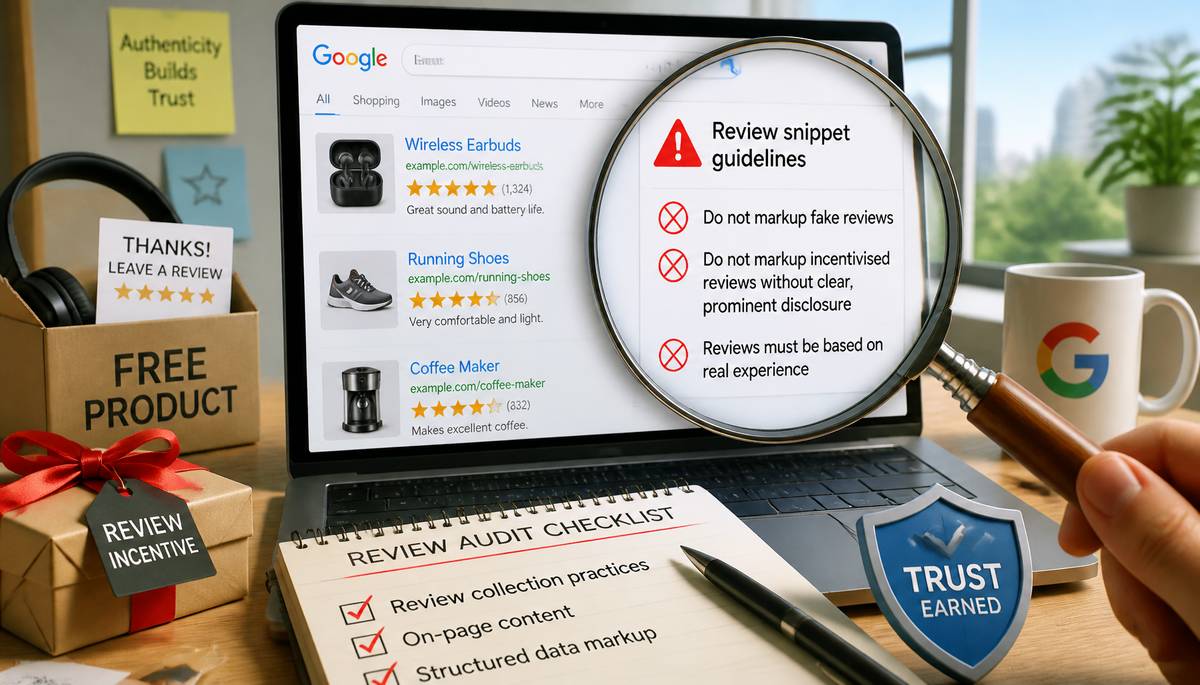 Google has quietly sharpened the knife. Its review snippet structured data guidance now explicitly warns site owners not to mark up fake reviews or incentivised reviews that aren’t properly disclosed.
That may sound blindingly obvious, but Google rarely adds wording like this for decoration. If it has spelled it out, chances are too many people have been stuffing polished nonsense into schema and hoping the search results won’t notice.
The update, added to Google’s review snippet documentation, says pages and structured data must not include reviews that are invented, or reviews written in exchange for money, discounts, vouchers or free products unless that arrangement is made clear and prominent. It also calls out reviews that aren’t based on a real experience with the product or service.
Review snippets, of course, are those little star ratings or short review extracts that can appear in rich results and sometimes in Knowledge Panels. Handy if they’re earned. A bit grubby if they’re bought like a dodgy watch from a bloke in a raincoat.
For businesses and SEO teams, the message is simple: audit your review collection practices, your on-page content and your markup. If reviews were nudged into existence with freebies and no disclosure, or they were never genuine to begin with, they’re now sitting directly in Google’s line of sight.
Posted on 25 July 2026
Google Says AI Search Sends Traffic. So Why Are Publishers Seeing Less?
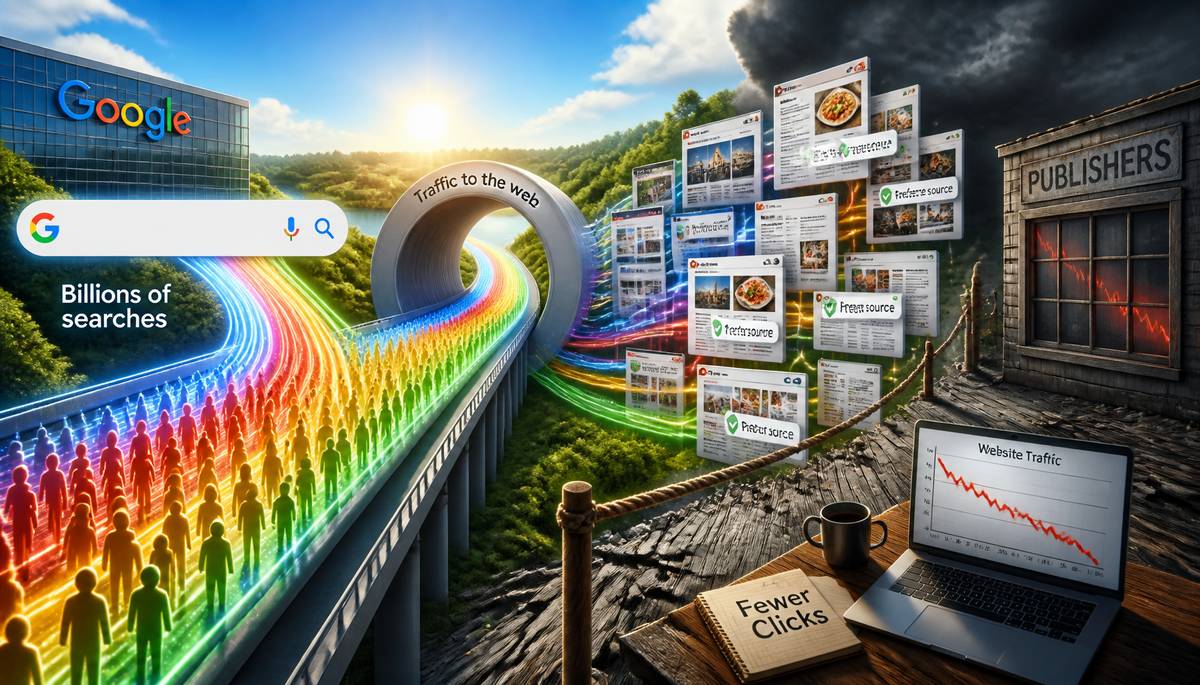 Google insists the web is still being fed. Nick Fox, the company’s senior vice-president for Search, says Google sends billions of visits to websites every day through Search overall, and billions each week from its newer search features alone. His argument is simple: people are asking more questions, using Search more often, and publishers are still getting traffic.
That sounds reassuring. It also jars with what many publishers are seeing in their own figures.
The unease is not hard to understand. Independent studies have suggested that searches ending without a click now account for 68% of activity, while another report found that automated answer boxes reduced clicks by 42%. Those numbers help explain why so many site owners feel as if the floorboards are shifting under them, even as Google says the house is busy.
Google has made small adjustments that appear aimed at easing that strain, including preferred source labels, tweaks to recipe links and other changes meant to improve referrals. Even so, the central complaint remains: broad claims are not the same as transparent evidence.
That is the real tension here. Google says the clicks are flowing, and this is the first time it has put a scale on traffic from these newer search features. But until the company shares fuller click data, publishers are left with two competing truths — Google’s assurances, and their own shrinking charts.
Posted on 19 July 2026
Google Quietly Turned Search Console Into A Social Traffic Spyglass
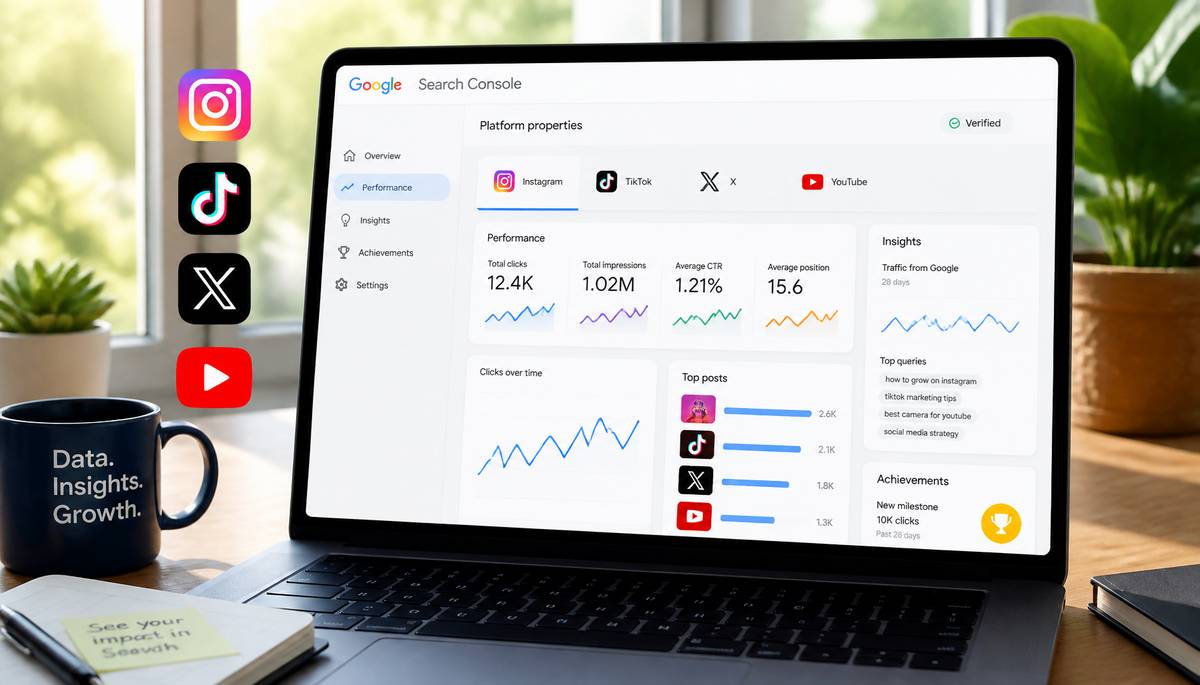 Google has slipped a rather telling new lens into Search Console: platform properties. Quietly. Like a librarian fitting a periscope.
The update lets you verify profiles on Instagram, TikTok, X and YouTube, then see how those posts and videos perform in Google Search. Not on the platforms themselves, crucially, but inside Google’s own results. That means clicks, impressions and related metrics in the performance report, plus filtering by queries and posts so you can see what actually pulled people in.
There’s also a broader insights view, showing traffic trends, top posts and how people are finding your account through Google. And, because somebody at Google enjoys a badge, achievements will mark milestones such as hitting a new click threshold over the past 28 days.
The practical bit matters most. Until now, Search Console has been strongest when tracking sites you own and control. Social profiles sit in a murkier corner. You publish there, but the reporting has often lived elsewhere. This begins to close that gap, offering a clearer picture of how third-party profile content performs in search.
Setup is straightforward enough: add a property in Search Console, choose one of the four supported platforms, then complete verification. The rollout is gradual over the next few weeks, so don’t panic if it hasn’t landed yet. It also sits apart from Google’s newer search profiles analytics.
Posted on 14 July 2026
The 15-Minute Audit That Can Save A Quarter Of Your Pipeline
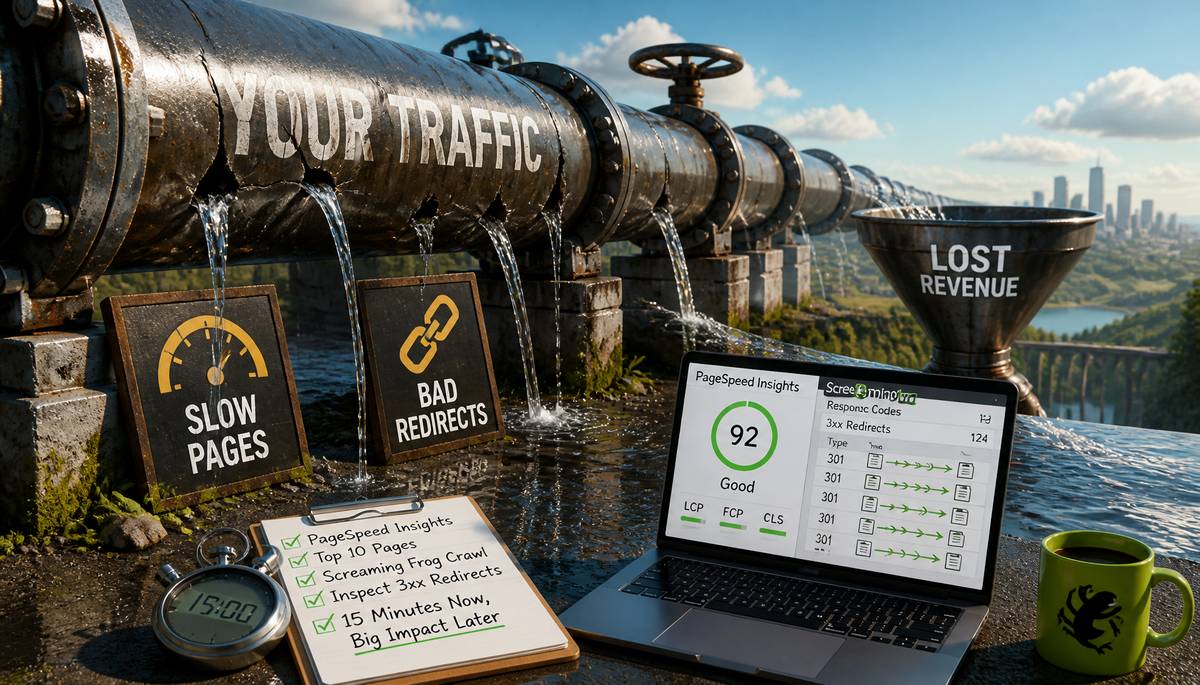 Traffic rarely vanishes with a bang. More often it leaks away like rain through a cracked roof, quietly soaking your pipeline before anyone looks up.
Two technical faults cause this more than most founders realise: slow pages and sloppy redirects. Neither looks dramatic. Both can hit revenue hard. Google has used page speed as a ranking signal since 2010, but the bigger issue is what speed does to buyers. Research from Deloitte and Google found pages loading in one second can convert at roughly three times the rate of pages loading in five. On mobile, shaving just 100 milliseconds improved retail conversions by 8%.
That is why a page taking more than 2.5 seconds to hit Largest Contentful Paint on mobile deserves attention now, not next quarter. Often the culprit is not your whole site, just bloated images, heavy scripts, autoplay flourishes and add-ons no one has properly justified.
Then there are redirects. A proper 301 helps search engines understand a permanent move and retain value from the old URL. But chains and lazy redirects to the homepage create what many SEOs call redirect debt. In practice, that can crush organic traffic after a migration.
This week, run your ten most valuable pages through PageSpeed Insights. Then crawl your site with Screaming Frog’s free version and inspect 3xx redirects. Fifteen minutes now may save a quarter of your pipeline later.
Posted on 8 July 2026
How to Spot an SEO Agency That Delivers, Not Just Talks
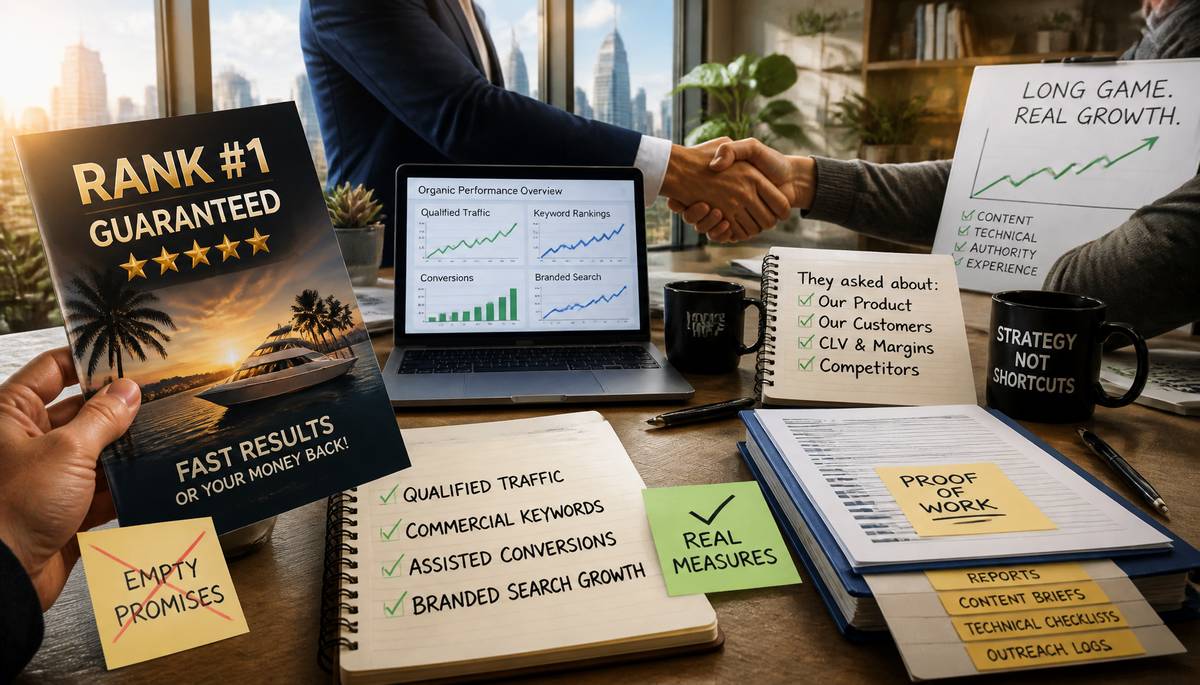 Anyone hiring an SEO agency should treat the sales pitch like a blind date: charm is cheap, and the bill arrives later.
The practical test is simple. Don’t ask for miracle rankings; ask how success will be measured. Google’s Search Essentials makes clear that nobody, not even Google, can promise a fixed spot in results. Useful measures are qualified traffic, commercially relevant keywords, assisted conversions and a rise in branded searches. Page-one boasts on their own are often window dressing. One outfit even hit a 60-day ranking promise by getting a company to rank for its own brand name, which is rather like claiming to have discovered your own front door.
Competence shows up in business understanding. A serious agency should know your competitors, ask about customer lifetime value and explain why some high-volume terms are useless bait. If a 45-minute call passes without questions about what you sell, who buys it and what margin you make, you’re not being advised; you’re being put through the mangle.
Ask for a domain-specific audit, even a small one, not a glossy deck. Ask to see redacted monthly work: reports, briefs, technical checklists, outreach sheets. Also pin down who will actually handle the account.
For competitive B2B SaaS, effective retainers usually start above $5,000 a month; past $15,000, expect full content, technical and outreach work. SEO is a long game. Better less of it than cheap busywork.
Posted on 3 July 2026
Meta Descriptions: Optional, Awkward, Still Worth Doing
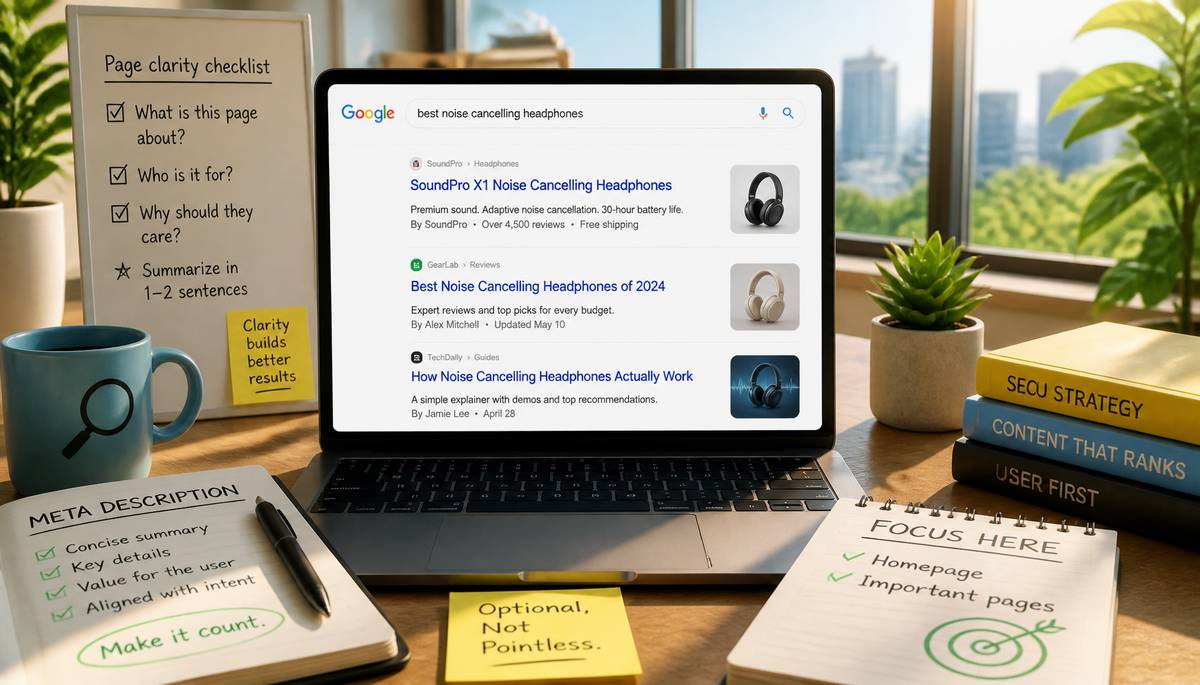 Meta descriptions are in the odd position of being both nonessential and still useful, which is very internet. Google’s John Mueller recently clarified on Reddit that there is no ranking penalty for leaving them out, and no requirement to write them at all. That has broadly been true for years, despite recurring SEO despair whenever Google swaps in its own snippet.
Google’s documentation says much the same: if writing descriptions for every page is too much, prioritise the important URLs, especially the homepage and popular pages.
That matters because a handcrafted description can still do jobs Google’s autogenerated snippet may fumble. On product pages, crucial details such as price, manufacturer, age, model, or reviews often live in separate parts of the page. A concise meta description can gather those fragments into one clear summary. The same goes for articles or blog posts, where author names, publication dates, and bylines may deserve prominence.
There is also a branding angle. Search snippets generated by Google are not always elegant, and businesses may prefer to control how key pages present themselves in results.
Mueller also made a more interesting point: writing a description forces clarity. Distilling a page into one or two sentences can reveal what it is actually about, and whether that matches the intended audience and topic focus.
So: optional, yes. Pointless, no. Especially on pages that matter. Posted on 30 June 2026
Google’s AI Answers Often Use a Brand’s Pitch, Then Recommend a Rival
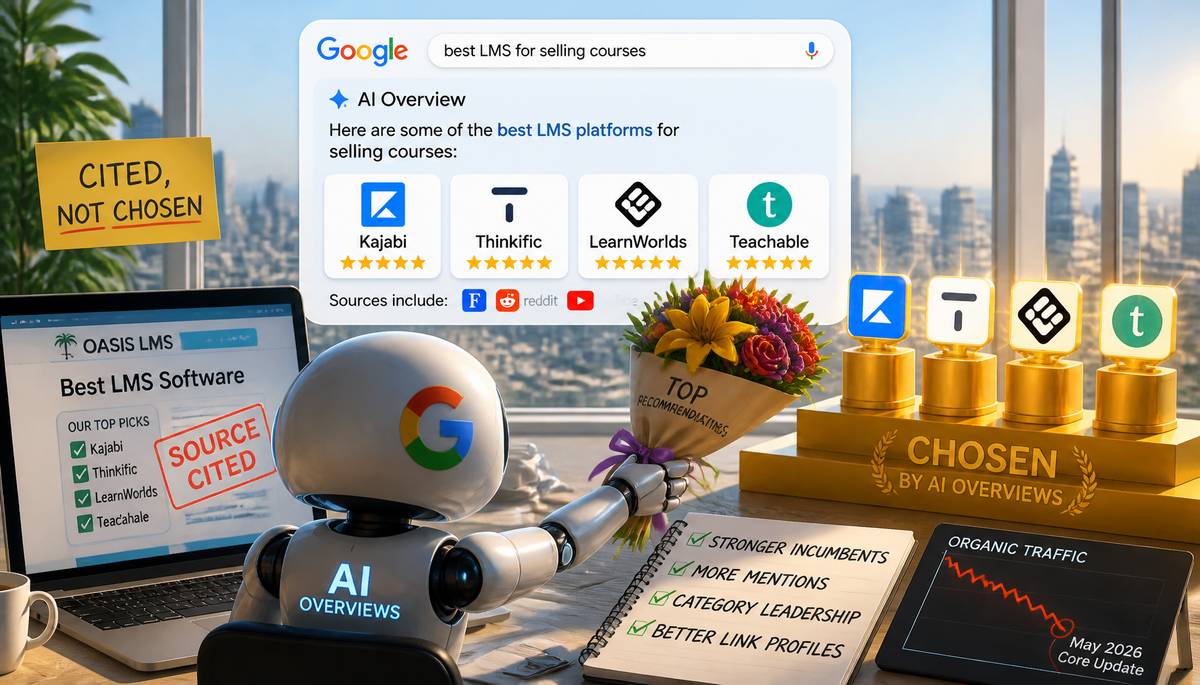 Google’s AI Overviews have a sly habit: they will borrow from a company’s own best-of page, then hand the bouquet to somebody else.
A new analysis by Lily Ray tracked 100 B2B searches for best [category] software on April 15, May 15, and June 8. Eighty of those queries produced an AI Overview. Across them, Google cited self-promotional listicles 323 times. Yet in 224 instances, the brand supplying the cited page was left out of the actual recommendations. That works out to 69% of cases.
The pattern showed up all over B2B software. For best LMS for selling courses, Google used Oasis LMS as a source, then recommended Kajabi, Thinkific, LearnWorlds, and Teachable, all named in Oasis LMS’s own article. Similar mismatches appeared in help desk, task management, survey, CRM, and SEO software.
The winners were usually stronger incumbents: brands with broader third-party mentions, category leadership, and better link profiles.
Ray also found that sites leaning hard on self-ranked best pages, AI-generated articles, comparison content, and GEO-focused publishing often saw organic traffic decline starting around Jan. 20, with losses deepening during Google’s May 2026 core update. Earlier work had found 30% to 50% visibility drops for some SaaS and B2B brands.
Meanwhile, Google’s citations increasingly favored outside sources such as Forbes, Reddit, and YouTube, with Reddit rising sharply. The lesson is plain: being cited is not the same as being chosen.
Posted on 20 June 2026
When a Quiet Export Rule Becomes an On-Off Switch for AI
 By late Friday, Anthropic had taken Fable 5 and Mythos 5 offline for everyone, not because the models had run amok, but because the U.S. Commerce Department sent a nonpublic enforcement letter invoking an obscure export-control rule. The order barred non-Americans, including Anthropic staff, from accessing the systems over an unspecified national-security concern. No court process appeared necessary.
Anthropic believes the trigger was a reported guardrail bypass, though the letter itself gave no details. That vagueness is the real story. A government agency demonstrated that it can, with remarkable speed, force a major U.S. software company to disable core products.
Weekend reporting complicated the official rationale further. Accounts from people familiar with the matter suggested the directive may have arisen less from a technical failure than from friction between Anthropic and the administration.
Katie Moussouris of Luta Security, after reviewing a private paper Anthropic shared with her, said the alleged bypass described by researchers at Amazon amounted to little more than reframing a request from identifying security flaws in code to fixing them. In practice, she argued, the capability is substantially the same, and trying to stamp it out would blunt defensive uses. She and many other security experts urged the government to reverse course, warning that removing advanced cyber capabilities from U.S. defenders is dangerous.
Justin Hendrix noted the broader damage: allies may now question whether American AI systems can be relied on for critical work if official intervention can arrive this abruptly.
Posted on 16 June 2026
When Google Stops Sending You Away
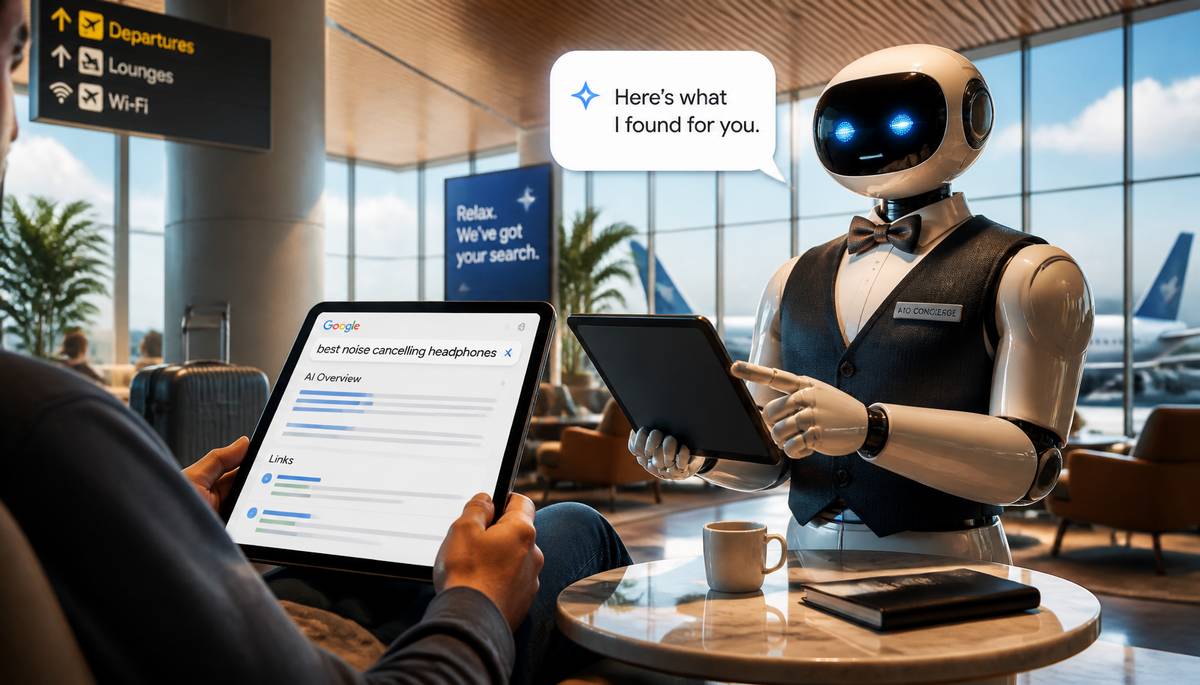 Google search used to be a vending machine: type a need, get links, wander off. Now it’s more like being trapped in an airport lounge with a robot concierge reading at you.
Analysis of about 846,000 anonymized U.S. Google sessions with Eric Van Buskirk of Clickstream Solutions found that when AI Overviews appear, classic intent signals stop predicting SERP behavior. Without an AIO, only 12% of navigational users are still on the results page after 21 seconds, versus 32% of local searchers. With an AIO, all five major intents — informational, local, navigational, transactional, and video — bunch together between 41.9% and 48.5%. Average SERP sessions become nearly four times longer.
That’s the real shift: search becomes a reading session. The old model sorted behavior by intent; AIOs flatten it. Direct answers keep people on Google longer because users now consume context before deciding whether to click.
For brands, that makes the second impression crucial: the back-scroll after users pass a listing once. Product pages need schema covering aggregateRating, reviews, offers, availability, plus strong review volume and multiple images. Category pages need ItemList schema, visible facets, and real depth. Blog posts need fresh datePublished or dateModified signals and named authors tied to sameAs URLs.
The content strategy built over the last three years still stands. What changes is the battleground: not what to publish, but how each result competes beside an AI answer.
Posted on 9 June 2026
Google Gives Publishers a Discover Front Door With Search Profiles
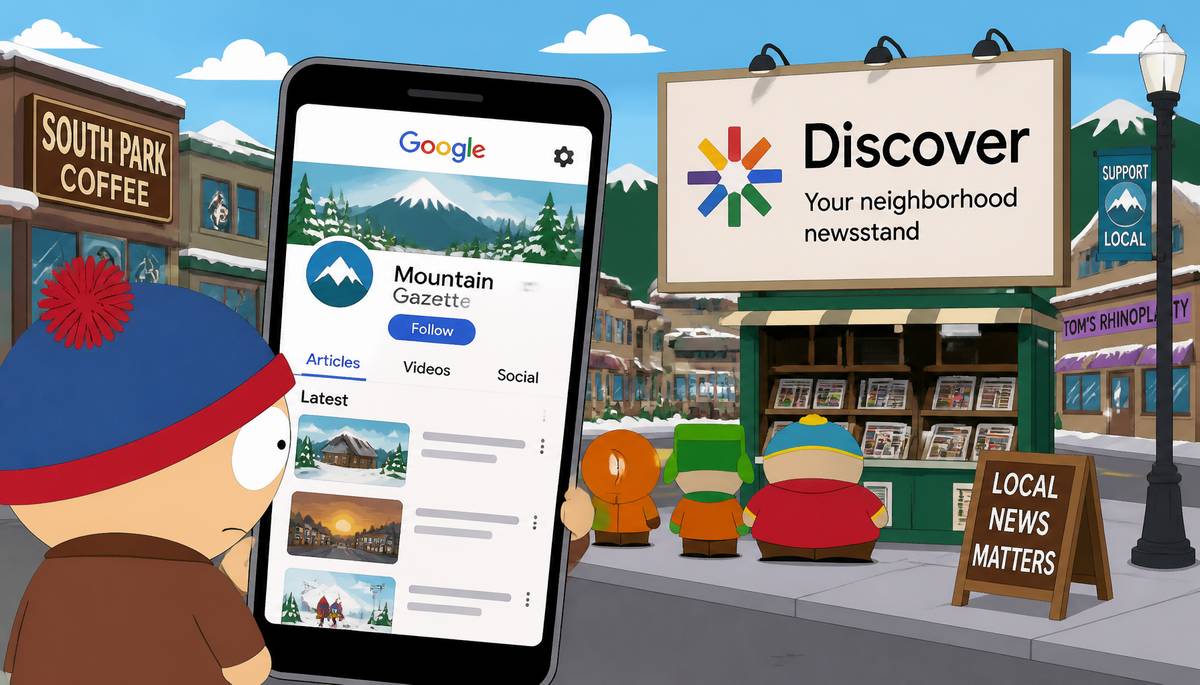 Google is giving publishers a new front porch inside Discover: Search profiles, now rolling out in the U.S. after months of testing and recent tweaks such as shortnames.
The feature creates a dedicated landing page for eligible publishers and creators. On one screen, users can see a large header image, follow the source, and browse its newest articles, videos, and social posts. The larger goal is obvious: keep audiences connected to trusted outlets across platforms while giving Discover another reason to act like the internet’s neighborhood newsstand.
Search profiles are being offered first to publishers and creators with sizable audiences on at least one major social or video platform. The current minimums are 300,000 followers on TikTok, or 100,000 on YouTube, Instagram, or X.
Eligible accounts can claim and customize a profile with an avatar, bio, website, and links to social and video channels. In some cases, claiming a profile may also create a Knowledge Panel. If a Knowledge Panel already exists, Google says it can be upgraded with a refreshed avatar, newer content, and a direct profile link.
For publishers, this is another Google visibility play: a cleaner brand hub, more chances to gain followers, and one more lane for surfacing recent work. The unresolved question is whether that added exposure will matter enough as AI keeps changing how people use search.
Posted on 8 June 2026
Google Trials Healthcare Ads in AI Mode With Tight Early Limits
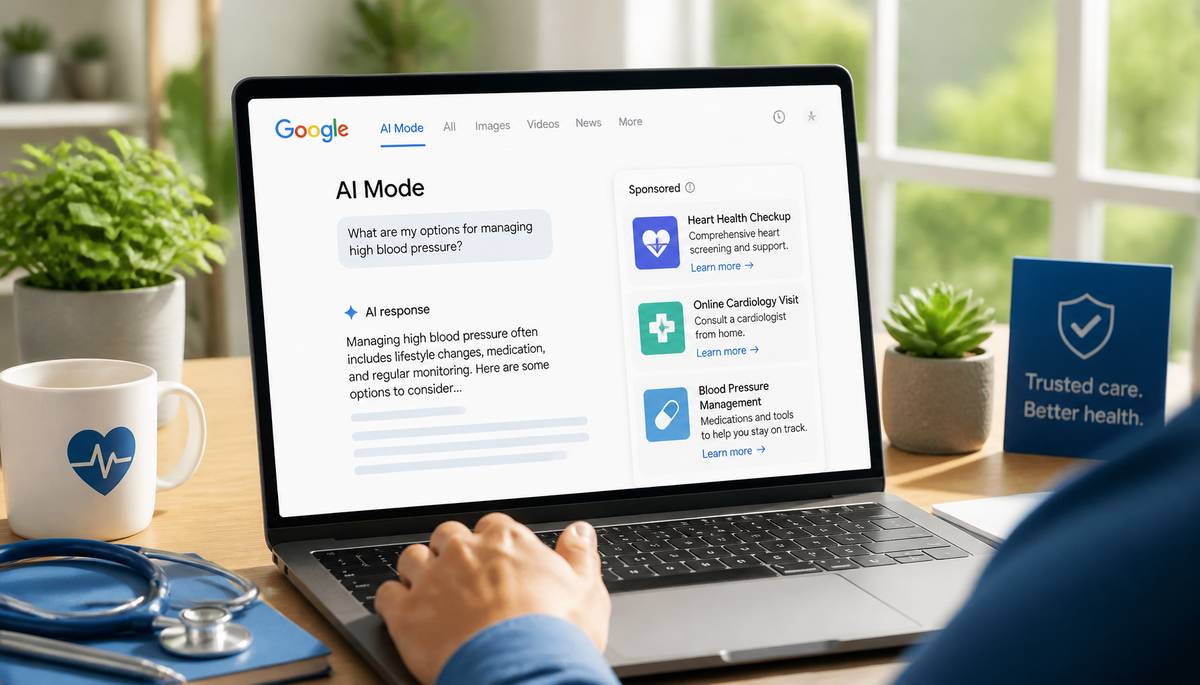 Google has started a limited U.S. trial of healthcare advertising inside AI Mode, its AI-led search experience, a small experiment with rather large implications.
The test covers English-language queries only and, for now, is restricted to healthcare advertisers. Google Ads Liaison Ginny Marvin confirmed the rollout after industry chatter about healthcare promotions appearing in AI-generated search results.
Several campaign types can be eligible in this test: Performance Max, AI Max with search term matching, Shopping campaigns, and broad match campaigns. Those same formats can also run in AI Overviews.
That matters because healthcare is among Google’s most tightly controlled ad categories. If adverts can be made to work here, within a space where accuracy, trust and regulation are not optional extras, it offers an early clue to how Google may earn revenue from AI search more broadly.
There are limits. The opening phase excludes creatives using pinned assets or text disclaimers, which reduces the number of healthcare ads that can participate.
So this is not yet a grand parade of AI-age medicine marketing; it is more like a carefully supervised lab test. Still, advertisers will be watching for any widening of access: more healthcare brands, more ad formats, and perhaps eventually other regulated sectors. The deeper question is how Google intends to fit monetization into AI search without unsettling user confidence.
Posted on 3 June 2026
How to Get Your Ads Inside Google’s AI Overviews Without Losing Your Mind
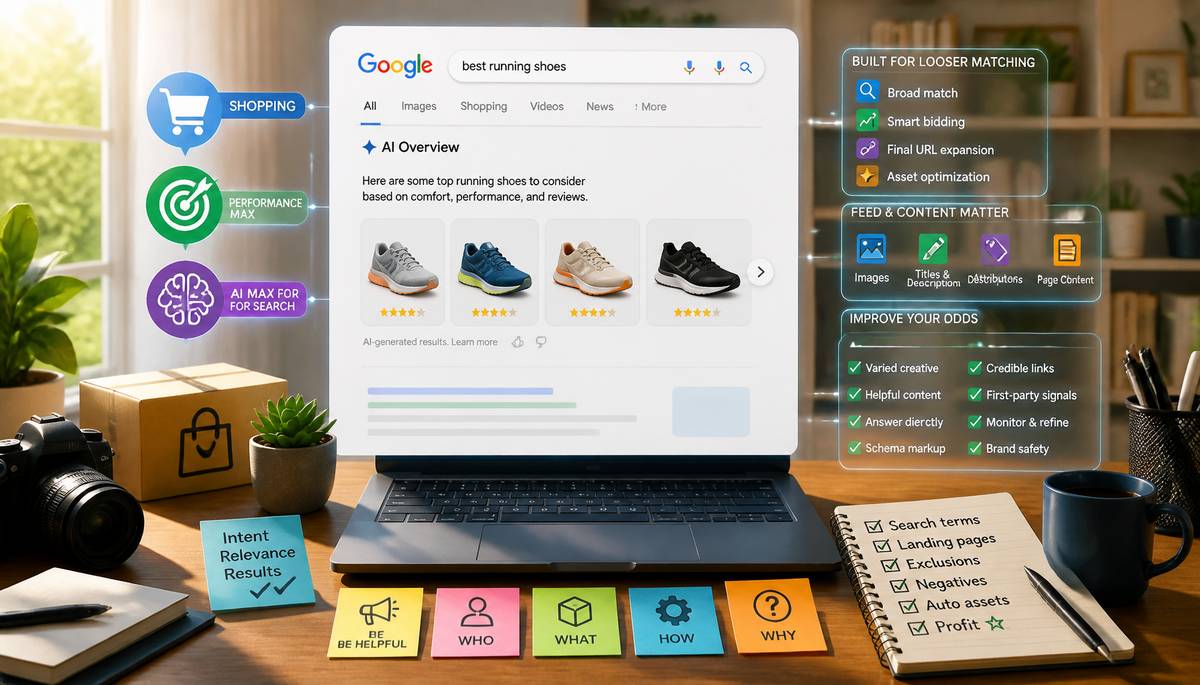 Google Search is turning into that friend who answers their own question before you can speak, which means advertisers now have fewer chances to win a click and more need to show up inside AI Overviews.
Google’s best bets for that placement are Shopping, Performance Max, and AI Max for Search. Translation: the campaign types many marketers side-eye because automation feels like letting a Roomba run your budget. But these formats are built for looser matching, where intent matters more than exact keywords.
Shopping lives or dies on feed quality: strong images, detailed titles and descriptions, and even optional attributes. That feed helps Google decide when a product belongs in AI-generated carousels tied to high-intent searches.
Performance Max leans on page content, product data, and audience signals. Turning on Final URL expansion gives Google more chances to match ads to relevant searches using landing-page context. AI Max for Search starts with existing keywords, then stretches beyond them with broad match, smart bidding, Final URL expansion, and asset optimization.
To improve your odds, use varied creative in multiple formats, write like a helpful human instead of a coupon siren, answer the who/what/how/why directly, tighten schema markup, add credible links, feed the system strong first-party audience signals, and keep monitoring search terms, landing pages, exclusions, negatives, and auto-created assets for brand safety and profit.
Posted on 2 June 2026
Small Businesses Are Disappearing in AI Search for Three Fixable Reasons
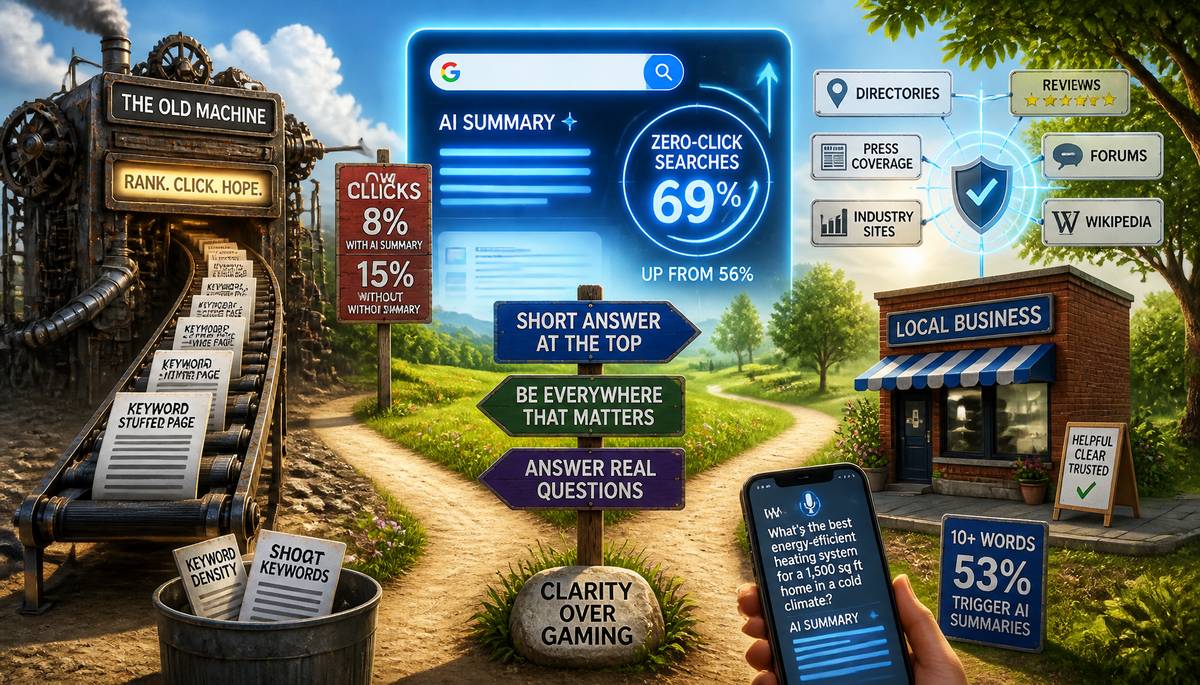 Search has changed shape, and many small businesses are still feeding the bones of the old machine. The old bargain was simple: rank, win the click, hope for a sale. But a Pew Research Center study of real browsing behavior shows that when Google displays an AI summary, users click a standard result only 8% of the time; without that summary, the rate is 15%. Similarweb reports zero-click searches rising from 56% to 69% in roughly a year.
Three habits now make firms hard to find.
First, pages built for keyword density fail when AI systems hunt for compact answers. These tools often lift a concise passage and present it directly. If the useful response is hidden deep in the page, another business with a clearer opening may be chosen instead. A short, stand-alone answer near the top now matters.
Second, a business that exists only on its own website is weaker in AI search. Pew found more than 88% of AI summaries cite at least three sources. Models draw from directories, reviews, press coverage, forums, industry sites and Wikipedia. Consistent mentions across the web build trust signals.
Third, businesses still chasing short keywords miss how people now search. Instead of plumber Birmingham, users ask long, detailed questions. Pew found searches of 10 words or more trigger AI summaries about 53% of the time, versus 8% for shorter queries.
Clarity, not gaming, is becoming the survival skill. Posted on 1 June 2026
Google Search Has Become a Browse Experience
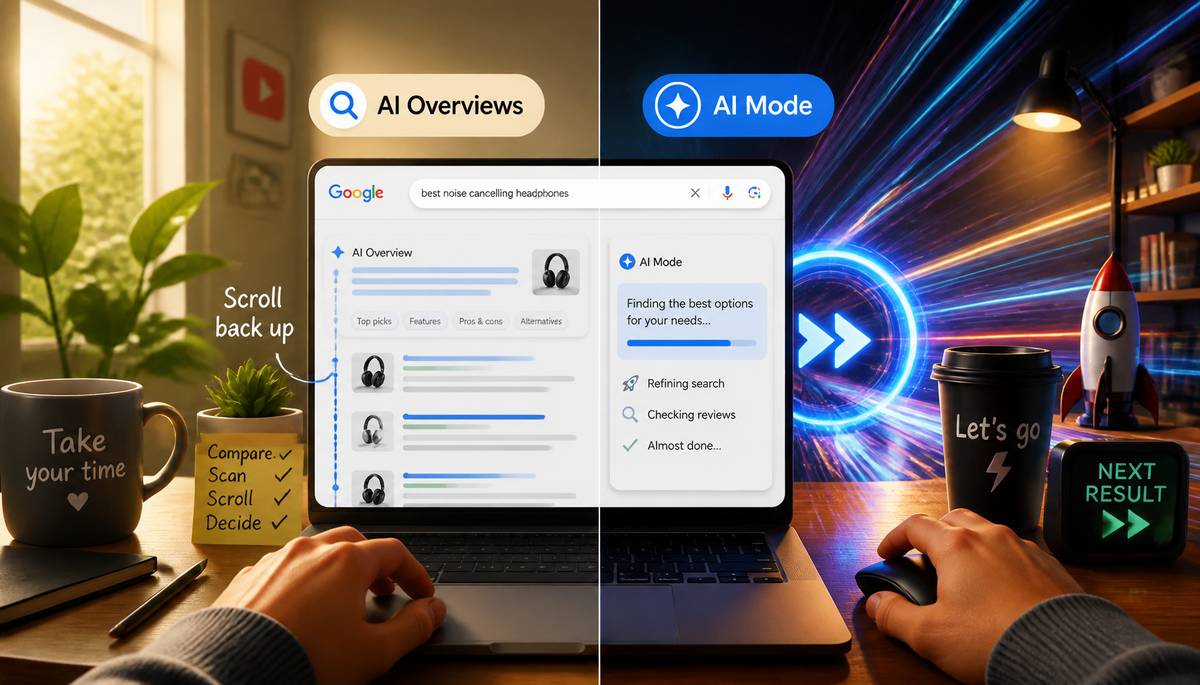 Google search now has two personalities, and they don’t even text each other back.
A new analysis of about 846,000 anonymized U.S. Google sessions from February and March 2026 shows that AI Overviews and AI Mode trigger opposite user behavior. AI Mode pushes people forward fast; AI Overviews make them linger, compare, and often scroll back up, more like browsing Netflix than picking a link and leaving.
The study, conducted by Eric Van Buskirk of Clickstream Solutions using clickstream data provided by Surfer SEO, is the fifth public look in 12 months at how Google users react to AI search features. Earlier work included a 70-user UX study in May 2025 and a 250-session AI Mode study in October 2025. This one sacrifices intimate screen-recording drama for scale, drawing from tens of thousands of search users, far beyond older mouse-tracking research that usually covered only dozens of people or a few thousand tasks.
Four shifts stand out: AI Overviews produce longer result-page evaluation, more reverse scrolling, weaker behavioral differences across search types, and fewer shortcuts on brand queries.
The practical implication is painfully modern: title tags and meta descriptions matter differently now. If users are looping, reassessing, and delaying clicks, search snippets have to win not just the first glance, but the second and third existential crisis too.
Posted on 31 May 2026
Google Pushes Trusted Sources Deeper Into AI Search
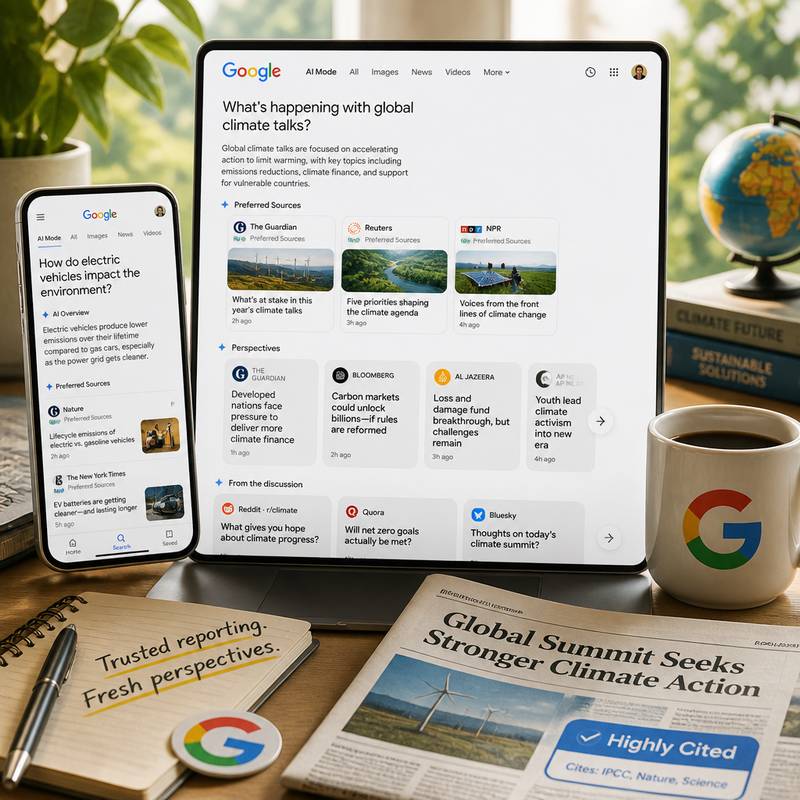 Google is giving its AI search products a little more main-character energy, with new tools meant to surface trusted reporting and firsthand takes faster.
The biggest change: Preferred Sources now appear inside both AI Mode and AI Overviews. If you’ve already picked publications or sites you trust, links from those outlets will be marked with a Preferred Sources label inside AI-generated answers, making them easier to spot. The feature is rolling out globally in every language. Google says people have already chosen more than 345,000 unique sources, and users are twice as likely to click a Preferred Source.
Another addition is a new perspectives carousel in AI Mode and AI Overviews. Google plans to show it when a search suggests someone wants to go deeper on an evolving topic. The carousel can feature timely articles, including content from a user’s Preferred Sources, and is designed to give fresher reporting more visibility across a wider set of queries.
Searchers may also see a related carousel built around perspectives pulled from online discussions, forums, and social media, which feels very internet in 2026.
Google is also widening use of its Highly Cited label across Search, beyond AI features. It will now appear on more article links, and Google will also note when a story directly cites a Highly Cited source, helping users identify the original reporting other coverage relies on.
Posted on 29 May 2026
When AI Enthusiasm Outruns Management
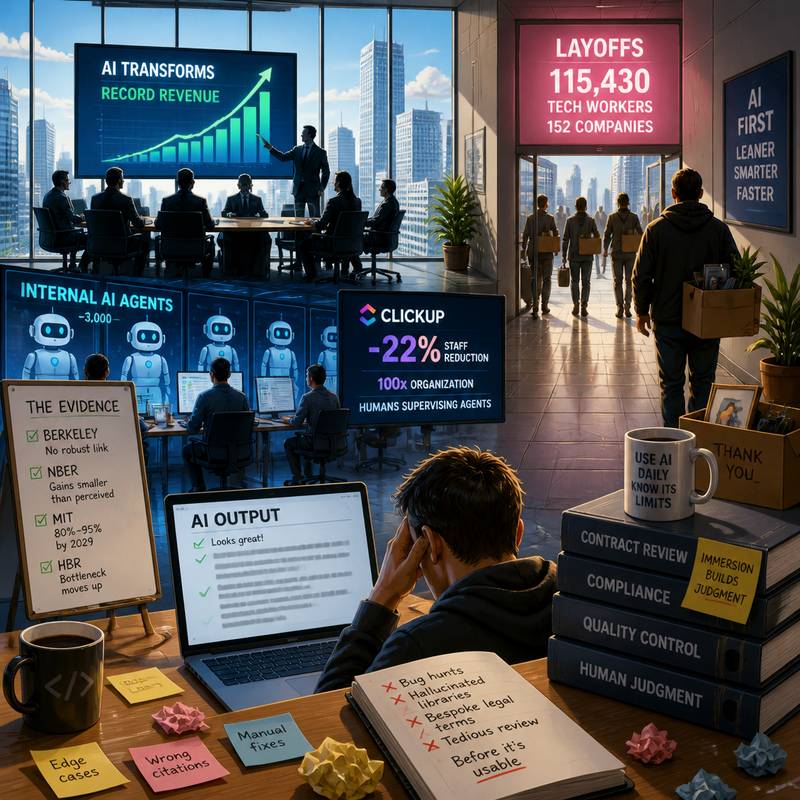 A familiar pattern is returning to technology: exuberance first, operational reality later. Yet the AI cycle is stranger than earlier transitions such as cloud computing. Companies are posting record revenue while dismissing workers at a historic pace.
One diagnosis came from Box founder Aaron Levie, who argued that CEOs are especially vulnerable to AI grandiosity because they are far from the final, error-prone stages where value is actually created. A prototype that drafts a contract or writes code can look transformative from the executive floor; less visible are bug hunts, hallucinated libraries, bespoke legal terms, and the tedious review required before output becomes usable. Levie is no skeptic: he promotes AI heavily, writes about agent-oriented software, and invests in AI startups. His advice is immersion—use AI constantly until its strengths and limits become equally clear.
That lesson is not widespread. Layoffs.fyi reports 115,430 tech workers cut by 152 companies in the first five months of 2026, versus 124,636 across 275 companies in all of 2025. Many firms cite AI, though critics see AI washing.
ClickUp CEO Zeb Evans said 22% of staff were let go after deploying about 3,000 internal AI agents, aiming for a 100x organization built around humans supervising agents.
The evidence remains sobering: Berkeley found no robust link between AI adoption and aggregate productivity; NBER found gains smaller than perceived; MIT estimates 80%–95% minimally sufficient performance on most text tasks by 2029, with true human outperformance later. HBR suggests the bottleneck simply migrates upward—to executives themselves.
Posted on 28 May 2026
Google Search Console’s Link Report Reverted to Older Data After Outage
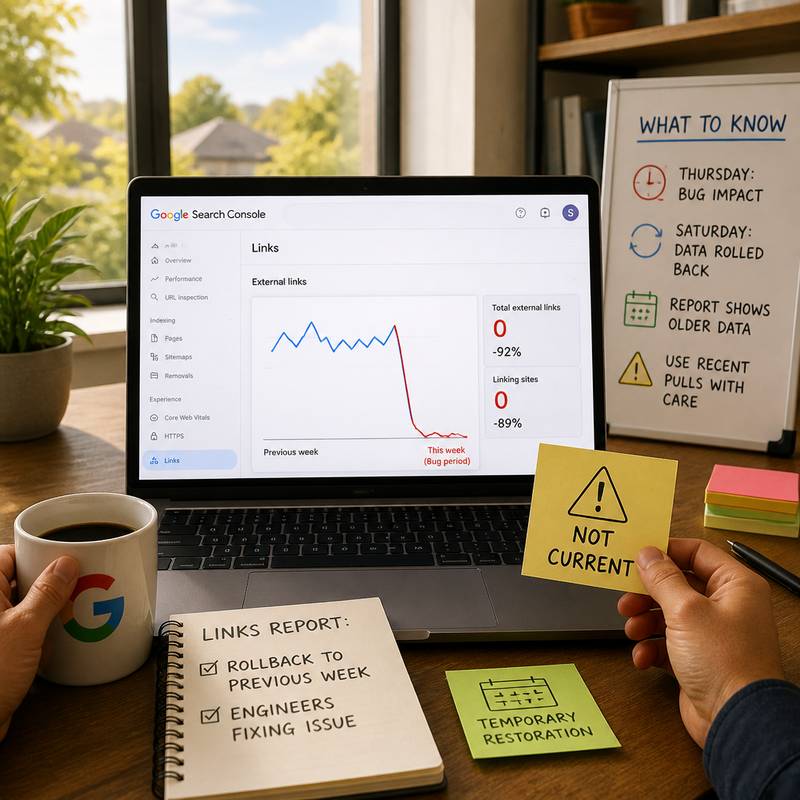 For a few days, Google Search Console’s links report became a faulty mirror. Beginning Thursday, some site owners opened it to find no links at all; others saw losses nearing 90% compared with the week before. The report had not become a record of reality, only of a break in the machinery.
Google acknowledged the problem. John Mueller first said the company would investigate, though the long weekend might slow the response. By Saturday, the missing links seemed to have returned, but the restoration was only temporary: Google had rolled the report back to data from the prior week while engineers worked on the underlying issue.
So the links report is currently visible, but not current. What it shows now is older data from weeks ago, not a fresh account of how Google is seeing links today.
That distinction matters. Anyone using the report for client updates or stakeholder summaries should treat recent pulls with care, especially data exported on Thursday, when the bug was at its most misleading. In some cases the report displayed zero links; in others, more than 85% appeared to vanish.
Google is still fixing the problem. Until that work is done, the report remains a useful tool only if users remember that its numbers belong to an earlier moment.
Posted on 27 May 2026
Google’s AI Search Advice Sounds Reassuring. That’s Why It Deserves Suspicion.
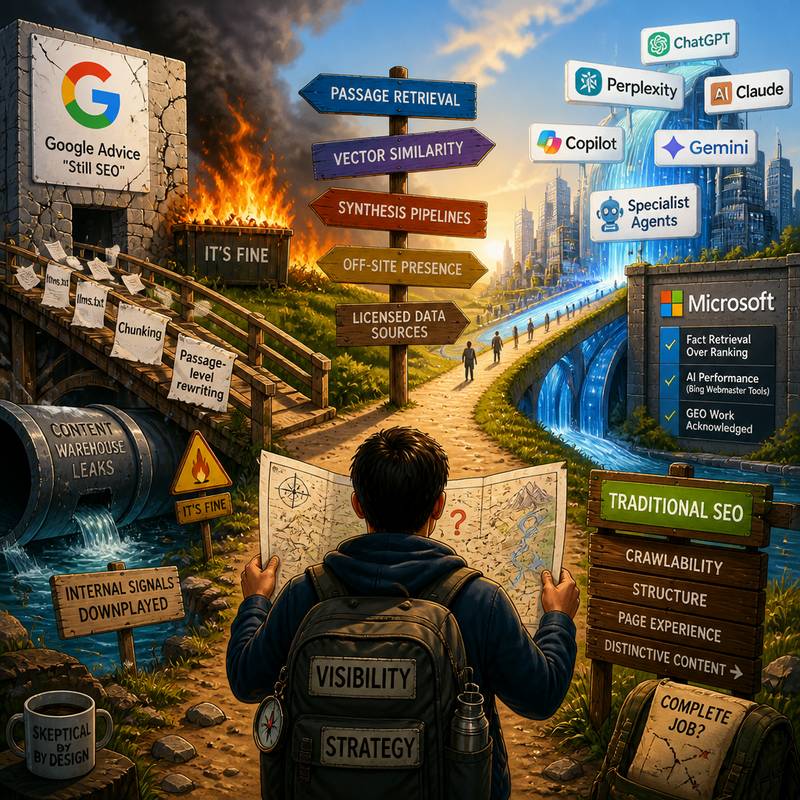 Google’s latest AI-search advice has big It’s Fine energy, and that’s exactly the problem. The company says optimizing for generative search is still SEO, while dismissing tactics like llms.txt, passage-level rewriting, and chunking. But that framing feels less like clarity and more like brand management.
The skepticism isn’t random. In 2024, leaked Content Warehouse documents exposed a gap between Google’s public guidance and its internal ranking systems, including signals it had downplayed. That history makes any tidy mythbusting document hard to take at face value.
The bigger issue is practical: AI search now spans Google, ChatGPT, Perplexity, Claude, Copilot, Gemini, and specialist agents. Traditional SEO still matters—crawlability, structure, page experience, distinctive content—but it no longer covers the full job. AI visibility increasingly depends on passage retrieval, vector similarity, synthesis pipelines, and off-site presence across places like Wikipedia, Reddit, third-party media, and licensed data sources.
Microsoft has been notably more explicit. Teams led by Krishna Madhavan and Jordi Ribas have described a shift from ranking pages to retrieving verifiable, groundable facts, shipped AI Performance in Bing Webmaster Tools, and acknowledged emerging GEO work.
Google may not use llms.txt, but Anthropic does. Google says chunking is unnecessary; Bing and Google’s own research on passage indexing suggest otherwise. In other words: useful advice, incomplete map. Posted on 25 May 2026
seolist.org (c)2009 - 2026